
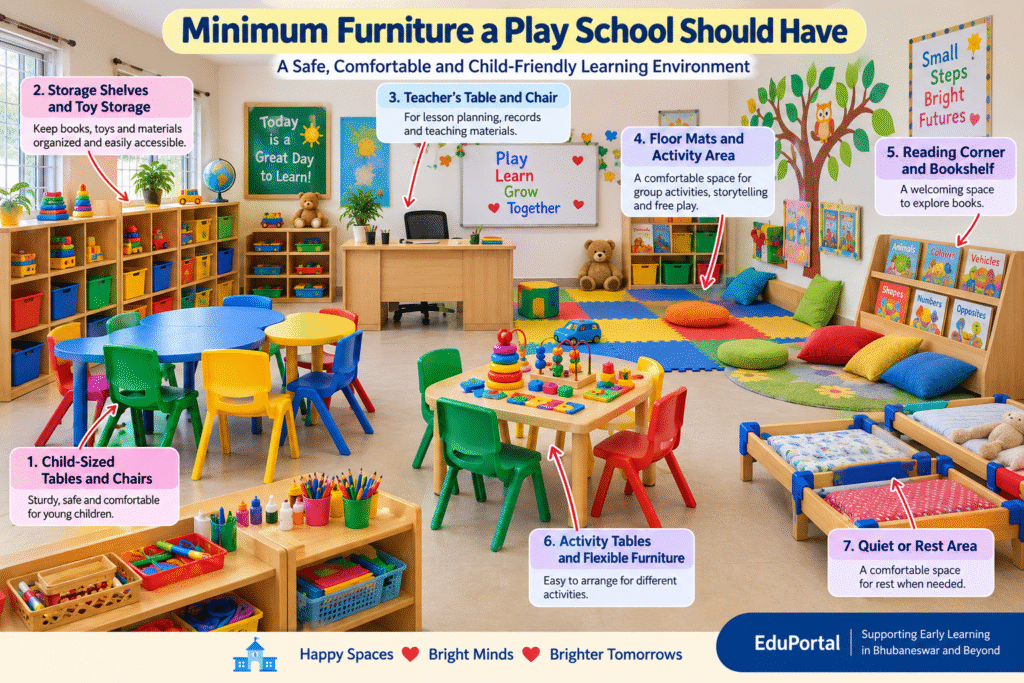
Minimum Furniture a Play School Should Have: A practical guide for play school owners, teachers and parentsSetting up a play school is not simply about putting small tables and chairs into a classroom. The furniture should be safe, comfortable, child-friendly and suitable for the activities that young children take part in every day.
For a new play school, there are many types of preschool furniture available, but it is not necessary to buy everything at once. A sensible starting point is to provide the basic furniture children and teachers need and then add more as the school grows.
This guide looks at the essential furniture that can help create a comfortable and useful play school classroom.
Child-Sized Tables and Chairs
Tables and chairs are among the most basic furniture requirements for a play school.
Children should be able to sit comfortably and use the table without having to stretch, climb or sit in an unsuitable position. Furniture should therefore be selected according to the age and size of the children using the classroom.
When choosing preschool tables and chairs, look for:
- Child-appropriate height
- Strong and stable construction
- Smooth, safely finished edges
- Easy-to-clean surfaces
- Comfortable seating
- Furniture that can be moved and rearranged when necessary
Colourful furniture can make the classroom attractive, but safety, comfort and suitability should come first.
Storage Shelves and Toy Storage
Good storage is an important part of a play school classroom.
Books, blocks, puzzles, art materials and toys can quickly make a classroom difficult to manage if everything is kept together without an organized storage system.
Low open shelves can allow children to see and access suitable materials with teacher guidance. Storage bins can be used for toys and activity materials.
Useful storage furniture can include:
- Low open shelves
- Book shelves
- Toy storage bins
- Storage baskets
- Small cupboards
- Separate storage for teacher-use materials
Shelves and cabinets should be stable and positioned safely.
Teacher’s Table and Chair
Teachers also need a suitable workspace for preparing activities, maintaining records and keeping teaching materials organized.
A teacher’s table and chair should be functional without taking up unnecessary classroom space.
Depending on the classroom, additional storage may be useful for:
- Lesson materials
- Teaching aids
- Records and stationery
- Art supplies
- Materials that should not be freely accessible to children
The teacher’s furniture should support classroom organization while keeping the main learning and activity areas open for children.
- Floor Mats for Activities
Floor space is an important part of a preschool classroom.
Children may sit on the floor for storytelling, group activities, games, building activities and other forms of learning through play.
A suitable floor mat can create a comfortable activity area and help define a particular part of the classroom.
A play school may create spaces for:
- Circle time
- Storytelling
- Building and blocks
- Group activities
- Free play
- Quiet activities
Mats should be easy to clean and kept in good condition.
Child-Friendly Bookshelves and Reading Corner
A small reading corner can make books a visible and accessible part of the classroom.
A low bookshelf or front-facing book display allows children to see the covers of books more easily. A few cushions or suitable seating can make the area comfortable.
The reading corner does not need to be large. Even a small, well-organized space can provide an inviting place for children to look at picture books and listen to stories.
Useful furniture can include:
- Low bookshelf
- Front-facing book display
- Small seating
- Cushions
- Storage for additional books
Activity Tables and Flexible Classroom Furniture
Not every classroom activity requires the same arrangement.
Teachers may need space for drawing, colouring, puzzles, blocks, group work or other activities. Furniture that can be rearranged easily can therefore be useful.
Small tables can be grouped together for activities or separated when children need individual workspace.
Flexible furniture can help a classroom serve several purposes without requiring a large number of different furniture items.
- Quiet or Rest Area
Some play schools may need a small area where children can rest or take a break from active activities.
Depending on the age group and school programme, this may include:
- Soft mats
- Cushions
- Small mattresses or suitable rest equipment
- Low storage for blankets or other necessary materials
The area should be clean, comfortable and appropriately supervised.
Not every play school will require the same type of rest furniture, so this should be planned according to the children’s age groups and the school’s programme.
Essential Furniture Checklist
For a play school starting with a limited budget, the basic furniture can include:
☐ Child-sized tables
☐ Child-sized chairs
☐ Safe storage shelves
☐ Toy and activity storage bins
☐ Bookshelf or book display
☐ Teacher’s table and chair
☐ Floor mats
☐ Basic activity-area furniture
☐ Suitable rest-area equipment where required
What Is Essential and What Can Wait?
A new play school does not need to purchase expensive or highly specialized furniture immediately.
The priority should be:
- Safe and suitable seating
- Tables appropriate for children
- Adequate storage
- Floor mats and activity space
- Basic book storage
- Teacher’s workspace
- Furniture needed for the school’s particular activities
More specialized furniture, decorative classroom units and additional activity furniture can be added gradually.
The best choice will depend on the children’s age, number of children, classroom size, activities and available budget.
What Parents Can Look for When Visiting a Play School
Parents can also learn something about a play school’s environment by looking at its classroom furniture.
When visiting a school, parents may consider:
- Are tables and chairs appropriate for young children?
- Is the furniture clean and in good condition?
- Are shelves and storage units safely arranged?
- Is there enough open space for children to move and play?
- Is there a comfortable area for group activities?
- Are books and learning materials organized?
- Does the classroom look welcoming and child-friendly?
Parents should remember that a classroom does not have to contain expensive furniture to be a good learning environment. Good organization, cleanliness, safety and appropriate use of the available space are equally important.
Final Thoughts
The furniture in a play school should support children’s comfort, safety, independence and learning through play.
A basic classroom does not need to be filled with furniture. A carefully planned combination of child-sized tables and chairs, safe storage, floor mats, bookshelves and activity areas can provide a strong starting point.
As the school grows, additional furniture can be introduced according to the needs of children and teachers.
For school owners, thoughtful furniture selection can help create a practical classroom. For teachers, good organization can make activities easier to manage. For parents, the classroom environment can provide useful clues about how a school approaches children’s comfort, safety and learning.
EduPortal will continue to share practical resources for play school owners, teachers and parents, along with information about play schools and early-learning options in Bhubaneswar.
RELATED RESOURCE
Part 2: Essential Toys and Learning Materials Every Play School Should Have
Part 3: Play School Safety and Facilities — What Owners, Teachers and Parents Should Look For