
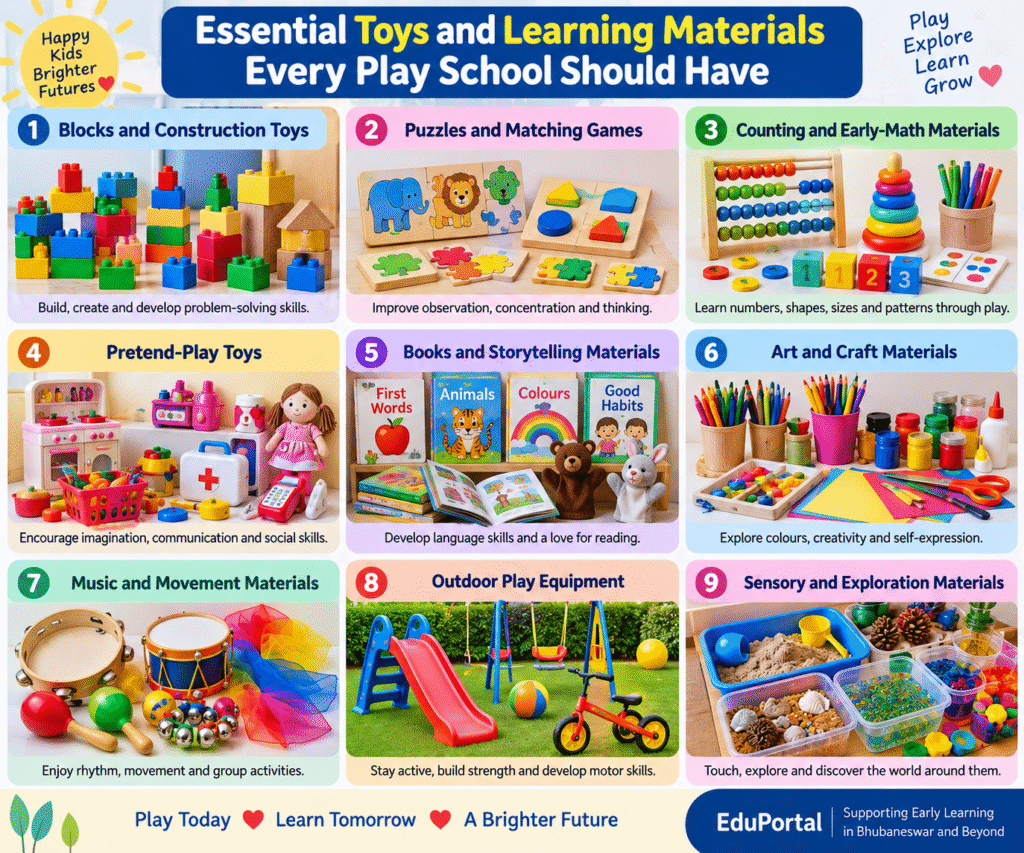
A practical guide for play school owners, teachers and parents
Toys are an important part of a play school, but a good preschool does not need to have hundreds of toys.
The most useful toys and learning materials are those that encourage children to explore, build, imagine, communicate, create and solve simple problems. Different types of toys can support different areas of early learning while making classroom activities enjoyable.
For a new play school, it is better to begin with a carefully selected collection of age-appropriate toys and gradually add more materials as the school grows.
Here are some of the essential toys and learning materials that can be useful in a play school.
Blocks and Construction Toys
Blocks are among the most useful toys in a preschool classroom.
Children can use blocks to build towers, houses, bridges and other structures. Building activities can encourage creativity, coordination, problem-solving and an early understanding of shapes, sizes and balance.
A basic collection may include:
• Large building blocks
• Wooden or plastic blocks
• Stacking blocks
• Interlocking construction pieces suitable for the age group
Teachers can also introduce simple building challenges as children become more comfortable with the materials.
- Puzzles and Matching Games
Puzzles can help children develop observation, concentration and simple problem-solving skills.
For younger children, puzzles with large, easy-to-handle pieces are generally more suitable.
Useful materials include:
• Picture puzzles
• Shape-matching games
• Colour-matching activities
• Simple sorting games
• Peg puzzles
• Memory and matching cards
The difficulty should be appropriate for the children’s age and developmental stage.
- Counting and Early-Math Materials
Early mathematical concepts can be introduced through everyday play rather than only through formal lessons.
Children can learn about counting, grouping, shapes, sizes, patterns and comparisons through simple hands-on materials.
Examples include:
• Counting objects
• Number cards
• Stacking rings
• Beads
• Sorting objects
• Shape sets
• Simple abacus-style materials
These materials can be used during both individual and group activities.
Pretend-Play Toys
Pretend play gives children an opportunity to use their imagination and recreate familiar situations.
A small role-play area can contain:
• Toy kitchen sets
• Toy food
• Dolls
• Doctor or medical-play sets
• Shop or market-play materials
• Toy telephones
• Simple household-play items
Pretend play can encourage children to communicate, cooperate with others and develop imaginative thinking.
Teachers can also use role-play to introduce vocabulary and simple social situations.
- Books and Storytelling Materials
Books should have a visible place in a play school classroom.
Picture books and simple storybooks can introduce children to language, new ideas, animals, people, places and everyday situations.
Useful materials include:
• Picture books
• Storybooks
• Concept books
• Alphabet and number books
• Picture cards
• Storytelling props
Teachers can also use puppets, picture cards or simple objects while telling stories to make group sessions more engaging.
Art and Craft Materials
Children should have opportunities to draw, colour, create and experiment.
A basic collection of preschool art materials can include:
• Crayons
• Colour pencils
• Drawing paper
• Washable paints
• Paint brushes
• Child-safe scissors
• Glue
• Modelling materials
• Simple craft materials
Materials should be selected according to the children’s age, and activities should be appropriately supervised.
Art activities are not only about producing a finished picture. They also give children opportunities to explore colours, shapes, textures and creative expression.
- Music and Movement Materials
Music and movement activities can add variety to the preschool day.
A play school does not necessarily need expensive musical instruments. Simple materials can be enough to introduce rhythm and movement.
Examples include:
• Small drums
• Bells
• Shakers
• Rhythm instruments
• Scarves or ribbons
• Age-appropriate music resources
Teachers can use these during songs, action rhymes, movement games and group activities.
- Outdoor Play Equipment
Children also need opportunities for physical play.
Where suitable space is available, a play school may provide age-appropriate outdoor equipment such as:
• Balls
• Tricycles
• Ride-on toys
• Slides
• Swings
• See-saws
• Climbing equipment
• Simple balance equipment
Outdoor equipment should be appropriate for the age group and regularly checked and maintained.
[IMAGE: Bright colourful preschool outdoor play equipment including slide, swings, tricycle and safe play area]
- Sensory and Exploration Materials
Children learn by touching, moving, observing and experimenting.
Depending on the school’s facilities and programme, teachers can introduce simple sensory and exploration activities using safe, age-appropriate materials.
Examples may include:
• Texture materials
• Sand or water activities where appropriate
• Natural objects
• Simple sorting and exploration trays
• Safe objects with different shapes and textures
Teachers should supervise these activities carefully and ensure that all materials are appropriate for the children’s age.
Essential Toys vs. Toys That Can Be Added Later
A new play school does not need to purchase every type of educational toy available.
A practical starting collection could include:
• Blocks and construction toys
• Basic puzzles
• Shape and sorting materials
• Counting materials
• Picture books and storybooks
• Pretend-play materials
• Basic art supplies
• Simple music and movement materials
• Balls and basic physical-play equipment
As the school grows, it can add more specialized toys, sensory materials, musical instruments, larger play equipment and other learning resources.
The priority should always be usefulness, safety and age-appropriateness rather than simply having a large quantity of toys.
Choosing Toys Safely
When selecting toys for a play school, safety should be considered before colour, appearance or novelty.
School management and teachers should check that:
• Toys are suitable for the children’s age
• Materials are safe and appropriate for children
• Toys are strong enough for regular classroom use
• There are no dangerous sharp edges
• Small detachable pieces are avoided where they may create a risk
• Damaged toys are removed
• Toys are cleaned and maintained regularly
• Teachers provide appropriate supervision
The same toy may be suitable for one age group but inappropriate for a younger group, so age suitability is important.
What Parents Can Look For
Parents visiting a play school can look beyond the number of toys displayed in the classroom.
Useful questions include:
• Are there different types of learning materials?
• Are the toys appropriate for the children’s age?
• Are books easily available?
• Do children have opportunities for creative activities?
• Are there blocks, puzzles or construction materials?
• Is there space for imaginative and pretend play?
• Are toys clean and well maintained?
• Do teachers actually use the materials during activities?
A classroom does not need to be filled with expensive educational toys. What matters more is whether children have suitable opportunities to play, explore, create and learn.
A Simple Starter Checklist
For a new play school, the following can provide a practical starting collection:
☐ Building blocks
☐ Simple puzzles and matching games
☐ Shape and sorting materials
☐ Counting and early-math materials
☐ Picture and storybooks
☐ Pretend-play toys
☐ Crayons and basic art materials
☐ Music and movement materials
☐ Balls and simple physical-play equipment
☐ Age-appropriate outdoor play equipment where available
☐ Safe and age-appropriate exploration materials
Final Thoughts
The purpose of preschool toys is not simply to keep children occupied.
Well-selected toys and learning materials can give children opportunities to build, create, imagine, communicate, move and discover new ideas through play.
A play school can start with a modest collection of useful materials and gradually expand it according to the children’s needs, available space and educational programme.
For school owners and teachers, thoughtful selection makes it easier to plan meaningful activities. For parents, the variety, condition and use of learning materials can provide useful insight into the classroom environment.
EduPortal will continue to share practical resources for play school owners, teachers and parents, along with information about play schools and early-learning options in Bhubaneswar.
RELATED RESOURCE
Part 1: Minimum Furniture a Play School Should Have
Coming next:
Part 3: Play School Safety and Facilities — What Owners, Teachers and Parents Should Look For
School directory badge
School administrators may display this badge to link to this Eduportal directory profile. It does not represent independent verification or a rating.