
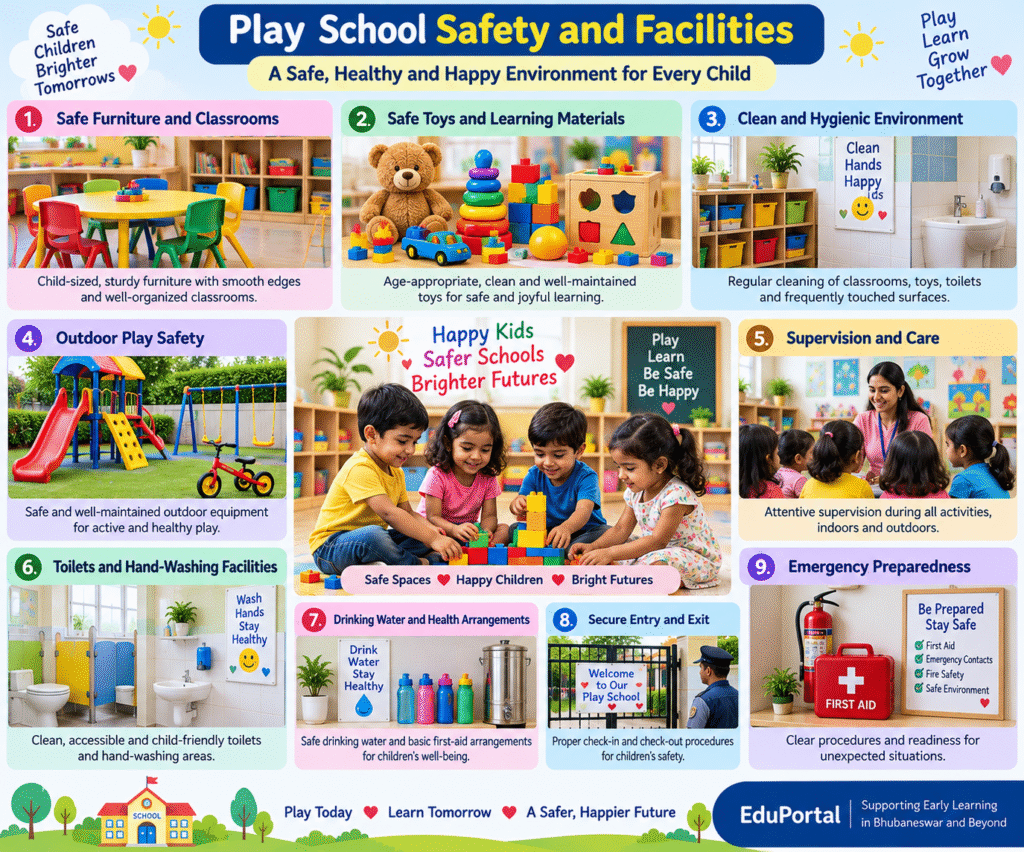
A practical guide to creating and evaluating a safe and child-friendly play school
For young children, a play school should be more than a colourful classroom filled with toys. It should provide an environment where children can play, learn, move around and interact with others while receiving appropriate care and supervision.
Safety is therefore an important consideration when setting up or running a play school.
School owners and teachers have the responsibility of maintaining a safe environment, while parents can also look at basic safety and facility arrangements when visiting a school.
This guide highlights some of the important areas to consider.
Safe and Suitable Furniture
Furniture used by young children should be stable, appropriately sized and maintained in good condition.
Schools should regularly check tables, chairs, shelves and other furniture for damage or loose parts.
Important considerations include:
- Child-appropriate furniture
- Stable tables and chairs
- Smooth and safely finished edges
- Secure storage shelves
- No exposed sharp edges
- Regular maintenance and inspection
Colourful furniture can make a classroom attractive, but safety should always come before appearance.
- Safe Toys and Learning Materials
Toys should be selected according to the children’s age and should be checked regularly.
Teachers and school management should remove broken or damaged toys and pay attention to small detachable parts that may not be suitable for younger children.
Schools should consider:
- Age-appropriate toys
- Strong and well-maintained materials
- Safe construction
- Clean toys and learning materials
- Appropriate supervision during activities
- Safe storage of materials that require adult assistance
The number of toys is less important than whether they are safe, useful and appropriate for the children.
- Clean and Hygienic Classrooms
Young children spend many hours in classrooms and activity areas, so cleanliness is an important part of a healthy school environment.
Schools should have regular routines for cleaning:
- Floors and mats
- Tables and chairs
- Toys and learning materials
- Books and activity areas
- Toilets and wash areas
- Frequently touched surfaces
Children should also be encouraged to develop simple hygiene habits such as washing their hands at appropriate times.
- Safe Movement and Activity Areas
A preschool classroom should provide enough space for children to move safely.
Furniture should not unnecessarily block pathways, doors or activity areas.
Schools can organize different areas for:
- Group activities
- Storytelling
- Free play
- Creative activities
- Building and construction
- Reading
- Quiet activities
A well-organized classroom allows children to move between activities without unnecessary obstacles.
- Outdoor Play Safety
Outdoor play gives children opportunities for physical activity and exploration, but outdoor equipment needs regular attention.
Schools should check equipment such as:
- Slides
- Swings
- See-saws
- Climbing equipment
- Tricycles
- Ride-on toys
- Balls and other physical-play equipment
Equipment should be appropriate for the age group and maintained regularly.
The play area should also be kept reasonably clean and free from obvious hazards.
- Supervision of Children
Even a well-designed classroom cannot replace proper supervision.
Teachers and caregivers should know where children are during classroom activities, outdoor play, transitions and other parts of the school day.
Supervision is particularly important during:
- Outdoor activities
- Water or sensory activities
- Art and craft activities
- Use of certain play equipment
- Movement between classrooms or activity areas
- Meal or snack times
The level of supervision should be appropriate for the children’s age and the activity taking place.
- Basic Toilet and Hand-Washing Facilities
Suitable hygiene facilities are an important consideration for young children.
Parents visiting a play school can look at whether toilets and hand-washing areas appear clean, accessible and suitable for young children.
Schools should encourage children to develop basic habits such as:
- Washing hands
- Using the toilet properly
- Keeping personal items organized
- Maintaining cleanliness after activities
Teachers and caregivers can help younger children when they need assistance.
- Drinking Water and Basic Health Arrangements
Children should have access to safe drinking water during the school day.
Schools should also have basic arrangements for dealing with minor injuries or unexpected situations.
School management should establish appropriate procedures for:
- First-aid requirements
- Contacting parents when necessary
- Recording relevant incidents
- Responding to emergencies
- Keeping important emergency contacts accessible
The exact arrangements will depend on the school’s size, age group and local requirements.
- A Comfortable Rest or Quiet Area
Young children may sometimes need a quieter space away from active play.
Depending on the age group and school programme, a school may provide a small rest or quiet area with suitable mats, cushions or other appropriate arrangements.
Such an area can also be useful when children need a short break from group activities.
- Secure Entry and Exit
Schools should pay attention to how children enter and leave the premises.
Parents may want to understand:
- How children are received in the morning
- Who is permitted to collect a child
- How visitors are managed
- Whether entry and exit areas are appropriately supervised
- What procedures are followed when a child is picked up
Clear routines can help reduce confusion during busy arrival and departure times.
- Emergency Preparedness
School management should have appropriate procedures for responding to emergencies.
Staff should know what to do in situations requiring urgent attention, and important contact information should be readily available.
Depending on the school’s facilities and applicable requirements, emergency planning may include arrangements relating to:
- Fire safety
- Medical emergencies
- Evacuation
- Emergency contacts
- Communication with parents
Safety planning should not simply exist on paper. Staff should understand the procedures relevant to their responsibilities.
What Parents Can Check During a School Visit
Parents do not need to conduct a technical safety inspection when visiting a play school.
However, they can observe the general environment and ask simple questions.
Look for:
☐ Clean and reasonably organized classrooms
☐ Child-sized and well-maintained furniture
☐ Safe and age-appropriate toys
☐ Clear activity and movement areas
☐ Clean toilets and hand-washing facilities
☐ Safe and maintained outdoor equipment
☐ Appropriate supervision
☐ Access to drinking water
☐ Basic emergency and first-aid arrangements
☐ A friendly and child-focused environment
Parents can also ask how the school handles illness, minor injuries, emergencies and authorized child pickup.
Safety Is More Than Equipment
A safe play school is not created simply by buying safe furniture and toys.
It also depends on everyday practices.
Teachers and staff play an important role in:
- Supervising children
- Checking classrooms and equipment
- Maintaining cleanliness
- Organizing activities safely
- Identifying potential hazards
- Communicating concerns to school management
- Helping children learn basic safety and hygiene habits
Good safety practices become part of the school’s everyday culture.
Final Thoughts
A good play school should provide children with a safe, clean, comfortable and welcoming environment in which they can learn through play.
For school owners, safety and facilities should be considered from the beginning rather than treated as an afterthought. Teachers need practical routines for maintaining a safe classroom, while parents can use simple observations and questions when evaluating a school.
There is no single checklist that will suit every play school. Requirements can vary according to the children’s age, school size, facilities and programme.
What matters is that the school takes children’s safety, hygiene, comfort and supervision seriously.
EduPortal will continue to share practical resources for play school owners, teachers and parents, along with information about play schools and early-learning options in Bhubaneswar.
RELATED RESOURCES
Part 1: Minimum Furniture a Play School Should Have
Part 2: Essential Toys and Learning Materials Every Play School Should Have
School directory badge
School administrators may display this badge to link to this Eduportal directory profile. It does not represent independent verification or a rating.